Illustrated by Tim Foley
Dan Rather's original prose book, What Unites Us, is a collection of essays, musings and observations with lots of autobiographical details, about American history and political climate. This graphic novel adapts many of the essays from the prose version. The historical events are not told in any sort of chronological order. Instead, Rather uses his perspective on key historical moments to illustrate bigger ideologies; things like "courage", or "patriotism." Rather attempts to explain what is special about America, what brings us together as a nation, but also what has worked to separate us, especially partisan bickering and political turmoil.
0 Comments
Fights: One Boy's Triumph Over Violence is an autobiographical memoir of Joel’s childhood. As a small boy, he is forced to learn how to fight in order to protect himself from kids at school and in his neighborhood. He makes the assertion that children are sponges so can only absorb so much violence and negativity before it explodes out of them, often violently as well. As he grows, Joel learns to control his outbursts and tries to get away from the constant threat of violence, but he is frequently the target of other people’s anger. As he becomes a teenager, he becomes a target for other males well don’t like how popular he is with the ladies, and he also gets on the wrong side of drug dealers.
Illustrated by Michael Sloan
In the Fall of 2016, the Aldabaan family receives word that they have been approved to travel from Jordan to the United States. Brothers Ibrahim and Issa are able to emigrate with their families, but they are leaving behind their mother and another brother and family. This is after they have all fled war-torn Syria. The eldest son, Naji, can't wait for the family to start their new lives in the United States, but the political climate has Ibrahim and his wife, Adeebah, unsure of what they're going in to. Once in Connecticut, they receive help from IRIS, a refugee resettlement agency, and told that they need to become self-sufficient within four months. The whole family adjusts to oddities of America, such as basements and Life Alert. Naji and his sister, Amal, start school and are treated as outcasts. The family constantly wonders if they've really left behind the worse life.
Illustrated by Sonia Paoloni and Thibault Balahy
Delve into the formation of the first all American Indian Rock Band: Redbone, as told from Pat Vegas’ perspective. Before they were a full band, Lolly and Pat Vegas played clubs in LA and jammed with some of the greats - Jimmy Hendrix before he was Jimi, Sonny and Cher, and more. They start to collect other talented musicians who were also passing as Hispanic Americans, and formed a band that then went on to proudly use elements of Native American instruments and musicality in their songs and display their Native American heritage. While they weren't always a commercial success, and their ancestry brought them discrimination and missed gigs, the members of Redbone felt it was necessary to continue their musical careers as noble Native Americans who would not bend to the pressure of their record label or the music industry.
Adrien Gombeaud & Améziane, illustrators
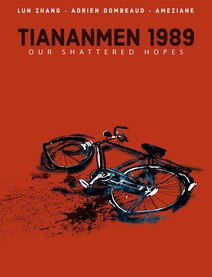
This historical graphic novel begins an explanation for the student protests beginning April 15th, 1989 and concluding in the Tiananmen Massacre on June 5th, 1989. Most people know of this event from the famous photo, Tank Man (pictured below). What isn't largely talked about is the months before this photo where students camped out in Tiananmen Square and inspired protests across China. Students and professors participated in Hunger Strikes against the Chinese government and demonstrated in the hopes that the country would move away from dictatorships and into democracy. The People's Liberation Army was called in to clear the square, but citizens of Beijing impeded their progress and protected the students. Wealthy businessmen became involved as financial backers of the protest. Some of these protests were captured by the Worlds' Press reports during a state visit from Mikhail Gorbachev, but there still exists a lack of certainty about those involved, number of deaths from the Massacre, and much more.
Co-written by Justin Eisinger and Steven Scott, illustrated by Harmony Becker
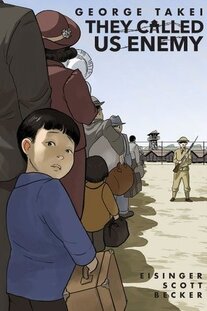
This graphic novel chronicles Takei's experience as a child being taken to an Internment Camp in WW2. Takei's family originally lived in the Losa Angeles area, so his family was initially taken to the staging area at a race track. Here, families were given one horse stall to occupy, usually without four solid walls and with dirt floors. After the camps were completed, Takei's family was moved first to Rohwer, a camp in Arkansas, then relocated to Camp Tule Lake in Northern California. In every place, the Japanese-American families proved their resilience as they tried to make the best of what was happening to them. Many more difficult Executive Orders were passed, like the one calling for Japanese Americans to disavow any loyalties to the Japanese Emperor, along with Executive Orders asking for interred Japanese Americans to serve in the US Military. This entire story is told from the perspective of an adult George giving a lecture in a packed hall. |
About MeI've been reading manga and comicbooks for years. Now, I write reviews and other helpful things for School Librarians, teachers, parents, and students. Search this siteRatings, Audience, and Subject Tags
All
Archives
July 2026
|